In recognition of Fraud Prevention Month, Équité Association and its members are releasing a comprehensive thought-leadership series designed to illuminate the most pressing fraud issues currently facing the insurance industry. This series is not just about identifying the problems, such as the $900 million auto theft claims costs in 2025, but about showcasing the innovative solutions being deployed to disrupt criminal networks.
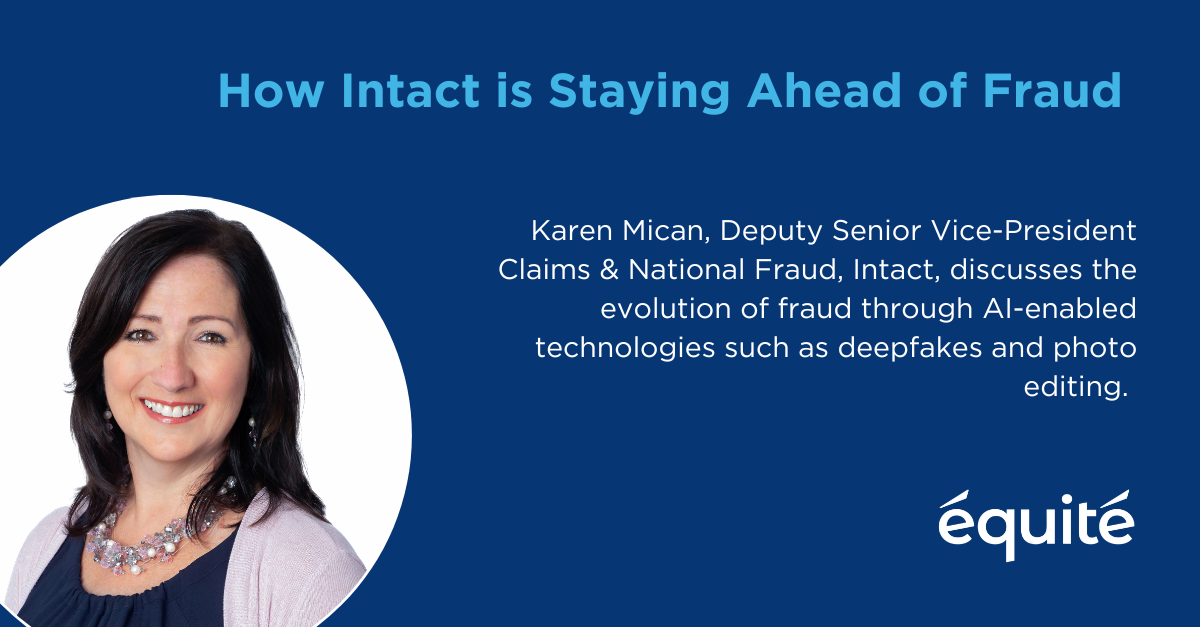
Karen Mican, Deputy Senior Vice-President Claims & National Fraud, Intact, discusses the evolution of fraud through AI-enabled technologies such as deepfakes and photo editing. Intact Insurance is Canada's largest home, auto and business insurance company, with over four million customers.
Équité: What are the biggest trends you’re seeing when it comes to fraud?
- Karen Mican (KM): Fraud evolves with the times. As AI tools become mainstream, fraudsters are faster, more scalable, and more convincing. What used to be bad cheques is now phishing emails, synthetic identities, and account takeovers.
In Claims, we’re seeing more AI-enabled fraud such as deepfakes and altering documents to falsify claims. For example, misrepresenting property or auto damage through photos found on the internet, or using AI or photo editing technology to alter or exaggerate damage. This type of fraud tends to increase when economic times get tight; following a legitimate loss, customers will exaggerate the extent or value of the damage for a larger settlement.
On the Underwriting side, we tend to see fraud stemming from information manipulation – for example, using false or misleading address information or other rating details to get a preferred rate.
Simply put, there are more ways to commit fraud and even small scams are getting more sophisticated. If we’re not keeping an eye on this, it can have significant long-term consequences for customers.
Équité: How is AI changing the fraud landscape?
- KM: AI is both an accelerant and an equalizer. On the threat side, it lowers the barrier to entry: image manipulation, document fabrication, and deepfakes are easier and cheaper to produce; furthermore social engineering scripts are more convincing. We’re seeing more AI-enabled schemes – fabricated documents, altered photos, voice cloning – and more opportunistic fraud driven by economic pressure. Inflation, rising premiums, and financial stress create conditions where otherwise honest people rationalize small lies that compound into large losses.
On the defense side, AI is strengthening detection. Our focus is deploying AI where it adds precision and accuracy; we then validate results with our in-house expertise – which includes former police officers, certified fire investigators and analysts – before taking action.
Équité: Why is it important for us to manage fraud?
- KM: Managing fraud keeps the insurance experience fair and customer-focused. When we detect fraud accurately, we put investigative effort where it matters most, instead of slowing down honest claims. That means faster cycle times and quicker resolution so customers can get back on track, while helping to manage premiums over the long-term and protecting people from fraudulent activity and mis-rated policies.
That’s why our industry collaboration is so essential. When we can combine our experiences, expertise and insight, we can align on best practices and look at how we can put safeguards in place to better protect customers. Our partnership with organizations like Équité on projects involving law enforcement help operationalize insights in fraud detection, prevention and deterrence.
Équité: Any final thoughts?
- KM: Fraud is dynamic. Economic pressure, AI democratization and sophisticated networks mean the threat surface keeps shifting. Our counter to this is equally dynamic: sharpened analytics, disciplined controls, cross-functional coordination and sector-wide partnerships. Vigilance by our teams paired with technical rigor is how we’ll stay ahead.
In an era of heightened risk, the insurance industry is more committed than ever to protecting clients from the impacts of fraud. Driving collaboration with government, law enforcement and other stakeholders, Équité and its members are strengthening fraud deterrence efforts to protect Canadians against insurance crime.